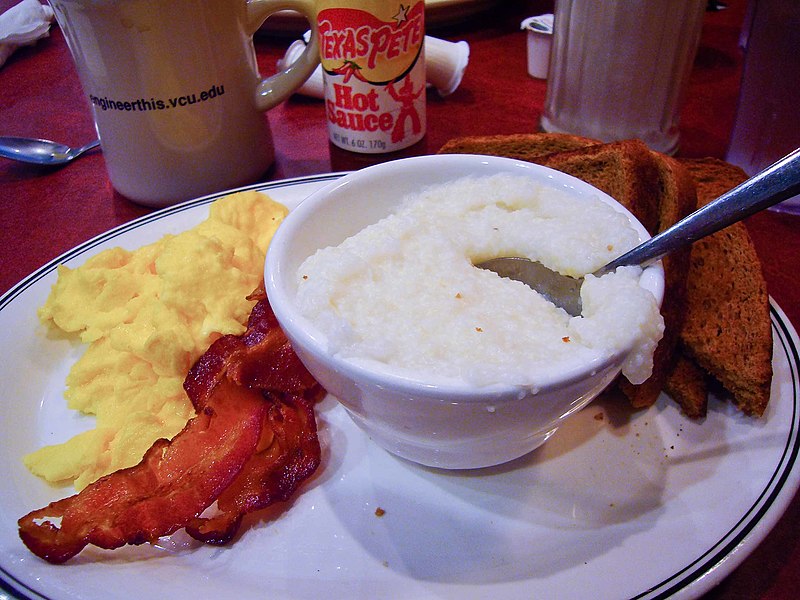
Grits is a food of Native American origin that is common in the Southern United States; it mainly consists of coarsely ground hominy. It is sometimes called sofkee or sofkey from the Creek word. The name 'grits' likely derives from the Northern European grit gruels. It is similar to other thick maize-based porridges from around the world, such as polenta. It also resembles farina, a thinner porridge. Grits can also be fried in a pan or mold to create a firm block. The resulting block can be cut with a knife or wire, and the slices are fried in a fat such as vegetable oil, butter or bacon grease.
Monday, 30 August 2010
The history of breakfast
Breakfast has commonly been practiced worldwide and is a concept easily transferred between cultures, but there have been many regional interpretations over the years. In Medieval Europe, for instance, the basic format of meals differed from what is currently 'standard', in that only two meals were to be had; a heavy dinner at noon and a light supper, largely due to the influence of the Church.
However, exceptions existed, most notably for children and people who were ill. They were allowed a small breakfast meal, and many labourers, farmers, and other physical workers also took the meal despite criticism and social pressure on them not to, and by the 15th century even the nobility had begun to ignore the rules and mores of polite society and took breakfast.
Perhaps the earliest appearance in print of the idea that "breakfast is the most important meal of the day" occurs in the novella 'Metamorphosis', published in 1915 by Franz Kafka, which includes the line, "for Gregor's father, breakfast was the most important meal of the day".
Breakfast Drinks
Breakfast beverage choices are fairly uniform worldwide, comprising
- Fruit juices (orange juice is the most popular),
- Milk (hot, cold, possibly cultured), milk analogue or hot soya bean milk in Vietnam and China,
- Hot caffeinated and decaffeinated beverages (tea, coffee, and chocolate).
Cultures around the world commonly shun or restrict alcoholic beverages at breakfast. (Alcohol is a depressant and a psychoactive drug, and so its effects might not be desired during working hours.) Notable exceptions would be the mimosa cocktail : champagne and orange juice (known as Buck's Fizz in the UK); Bloody Mary Cocktail : vodka and spiced tomato juice; and liqueur coffee: a coffee brew with a 25 ml (1 imp fl oz; 1 US fl oz) shot of liqueur, which generally has a lower alcohol content than spirits (around 15 to 30%). Still, a mimosa is normally served at brunch, and rarely consumed before 10 am. Another notable exception is the Champagne breakfast, a full western breakfast accompanied by sparkling white wine; usually saved for special occasions.
Sunday, 29 August 2010
Statisitcs on food waste
- Every year 18 million tonnes of edible food end up in landfill.
- Approx 1/3 from producers/ supply chain, 1/3 from retail and 1/3 from households
- Annual value : £23 BILLION [and rising rapidly due to soaring prices]
- Massive environmental damage and landfill costs to dispose
- Disposal costs to business passed on to consumers in higher prices, landfill costs in local taxes – less income
Article from : The Guardian
From the field to the home, UK may be worst in world for waste.
John Vidal, environment editor
Friday 15 April 2005
The Guardian
The British may waste more food than any other nation, throwing out 30-40% of all the produce they buy and grow each year, according to research. Figures collated from the government, supermarkets, processors and farmers show that modern food production methods may appear efficient, "but the reality is that large-scale manufacturing and rigid supply chains are creating very significant quantities of waste".
It is estimated that the wasted food is worth between £8bn and £16bn a year.
"The food sector now accounts for over a third of all the waste produced in the UK, a total of 17m tonnes," says the research, by C-Tech Innovation, a manufacturing consultancy. "About 15% arises from food manufacturing and a further 21% from distribution, retailing and consumption."
It notes that US food wastage is running behind Britain at about 25%, and that 4 million people in the UK "cannot afford a healthy diet and that one in seven people over 65 are at serious risk of malnourishment".
Separate government figures show that some 17m tonnes of food worth up to £20bn a year are being put into landfill, even though approximately 25% of it could be safely eaten by people or animals, or turned into compost and energy. The cost of transporting it and throwing it into landfills is thought to be more more than £175m a year.
Guardian research, backed by BBC Radio 4's Costing the Earth programme broadcast last night, suggests the increasing amount of food waste - thought to be rising roughly 15% a decade - is being experienced across the whole food chain from the field to the house.
"It is increasing at a phenomenal rate. We are buying more, but we are also abdicating responsibility, too. It's easy to let the food industry tell us what to do," said the food charity FairShare, which collects surplus - but edible - food from hundreds of canteens, retailers, supermarkets, manufacturers and restaurants, and distributes 2,000 tonnes of food a year to voluntary groups, who feed more than 12,000 old and otherwise vulnerable people a day.
FairShare has estimated that the edible food thrown away could feed more than 250,000 people. "We could easily increase what we collect and distribute," said a spokesman yesterday.
The waste starts with farmers, who are frequently forced to plough up or dispose of large amounts of perfectly good fruit and vegetables because of rigid contracts with processors or retailers. These usually specify the size and shape of fruits and vegetables, and the exact number needed.
"If you have even a small increase of temperature, you may see a 10-20% increase in crop yields," said Phil Hudson of the National Farmers Union.
"There may, however, be no home for this food because of extremely tight programmes by the industry. Some years ago, the extra food produced might have gone to wholesalers, but this market is now only about 15% of the total, and it cannot take surpluses."
Consumers were also largely responsible for wastage, said Mr Hudson. "We now always look for a specific size and shape of food in supermarkets. Anything outside that is left on the shelf. But is this human nature or are we being conditioned by retailers to look for this? We have certainly created a level of expectation which encourages large scale waste."
A recent report for Prudential Insurance, based on a survey of more than 1,000 households, found that 61% of people admit throwing out at least one bag of salad each week without even removing the packaging. A similar percentage threw away unused loaves of bread and fruit, while slightly fewer threw out milk, cheese and meat. Also regularly wasted were prepared meals.
According to Biffa, one of the largest waste handlers in Britain, households now throw out more than supermarkets and the food processing industry combined. Food waste is roughly one third by weight of all the waste produced by households.
"People just buy more than they can eat," said Peter Jones, a Biffa director.
"We estimate that each family now throws out about 2.7kg (6lb) of food per person per week," said East London Community Recycling Partnership, which collects and monitors the food waste of thousands of households on several housing estates and then composts it before giving it back to people for window boxes, allotments and garden use.
"The amount of food being wasted is increasing all the time," said Cam Matheson, who runs the East London scheme. "We are not allowed to sell it, because of animal byproducts, but composting like this could easily be extended to every housing estate in Britain."
The food manufacturing industry, which prepares convenience foods, sandwiches, tinned food and processed food, throws away at least 1m tonnes a year, Mr Jones said. New regulations which apply to anyone handling food for humans or animals are also encouraging the food industry to reject food, he said.
According to Biffa, supermarkets and other retailers throw out about 500,000 tonnes of food a year, of which only a small proportion goes to charities. Supermarkets are reluctant to say how much food is wasted, but it is possible to estimate from information put on their websites and in annual reports.
Tesco, which dominates British food retailing, says it sent 131,000 tonnes of waste to landfill in 2004, of which "the majority was food". Sainsbury's, which distributes surplus food to more than 400 charities, says it sent 91,000 tonnes to landfills, of which at least 70,000 tonnes is believed to be waste food. Most retailers say they have significantly reduced the amount of food wasted each year since 2000.
Better storage and distribution of food by supermarkets has reduced the amount of waste to only about 0.5% a year, industry sources say, but the total tonnage is enormous. The Environment Agency has estimated that the food and drinks industry generates 10% - about 10m tonnes - of the total waste produced by all industrial and commercial activity in the UK.
"A very few people remember rationing, but most of us have no idea what it is like not to have enough food," said Jeanette Longfield, coordinator of Sustain, a group of more than 100 food, environmental and other charities and unions. "The only justification for chucking stuff is because it is unsafe. We don't know how it is produced so they chuck it out without thinking."
Where it goes
Supermarkets: Up to 500,000 tonnes may be wasted each year, mostly because it is approaching its sell-by date. Some supermarkets make food available to charities and more composting is done. But the majority is landfilled, the cheapest option, in its packaging. In future it will be illegal to landfill any food derived from meat. This will encourage incineration.
Households: Up to a third of food bought may be wasted because we buy too much and do not plan menus. Much is discarded when it is near its sell-by date and people no longer eat everything on their plate. Processed food is increasingly rejected before it has been unpacked. Less is composted as most food is processed and vegetable growing has declined.
Farmers: Some 30%-40% by weight of all food grown can be lost. Retailers and food processors demand unblemished, specifically sized, shaped and coloured food. Bumper crops resulting from high temperatures cannot always find a market because of the declining wholesale trade . Food is usually ploughed back in to the fields.
Saturday, 28 August 2010
Breakfast in... The Middle East
Egypt
In Egypt the traditional breakfast is 'ful medames' : slow cooked fava beans (sometimes with lentils) dressed in olive oil, lemon juice and garlic.
Iran
In Iran, varieties of Iranian flatbreads (naan), Iranian feta cheese (panir-e irani) or Persian feta cheese, butter (kareh), a variety of traditional marmalades (morabba) or jams, honey (angebin or asal), cream (sar sheer) and hot tea are essential breakfast foods. Other foods, such as heavy cream, walnuts, hard and soft boiled eggs, and omelettes are also popular for breakfast. Traditionally, a choice of butter and cheese, butter and marmalade, heavy cream and honey, butter and honey, or cheese and walnuts are rubbed on fresh bread and folded into bite-sized sandwiches and are to be consumed with hot tea. The tea is preferably sweetened with sugar. Another breakfast food, which is usually consumed between the hours of three to five in the morning, in winter, is called halim. Halim is a combination of wheat, cinnamon, butter and sugar cooked with either shredded turkey/chicken or shredded lamb in huge pots. It is served hot and cold, but preferably hot. Almost everywhere in the country, especially in colder regions, a lamb head stew (kale pache) is consumed, usually on the early hours of weekend (Friday mornings).
Israel
An Israeli breakfast typically consists of coffee, orange juice, fresh vegetables salad, goats/cows cream cheese, fresh bread or toast, olives, butter, fried eggs of your choice, and some small cookies or slices of cake. For an even fuller breakfast it might include hard-boiled eggs, cottage cheese, quark cheese, and Israeli salad. Another type of breakfast would be fried dough, 'malawach' served with sweet fruits or something spicier. Hotels with continental, in addition to the aforementioned items, will usually serve many different kinds of fish and yogurts, as well as a dish of egg and spicy tomatoes known as 'shakshuka'.
Lebanon
In Lebanon, there are several types of breakfast, including include 'labneh', 'mankoucheh', 'lahm bi ajin', 'kichek' and 'knefeh'.
Mashriq
In the Mashriq, breakfast varies greatly according to taste, but a typical breakfast consists of tea or instant coffee, juice, a morning salad (cucumbers, tomatoes, onions, mint and olive oil), pita bread dipped in rich 'labneh', a type of yogurt, or in olive oil and 'za'atar' (a common Middle-Eastern spice mix). This breakfast is by far the most polular in most Arab areas. Hummus, ful medames and falafel are more common on the weekends. Other breakfast items include a variety of olives, cheeses, especially goat cheese, variety of vegetables, cereals, jams and pastries.
Other popular breakfast foods in the Mashriq include boiled eggs, olives, cheese and fava beans.
Breakfast in... Latin America
Latin American breakfasts feature many items seen in North American and continental European breakfasts in regional variations, according to their own culture.
In northern South America, maize-based breads, such as tortillas or 'arepas', may dominate or be augmented with wheat breads or pastries. Caffè, caffè e latte, hot chocolate, and tea are common beverages.
Argentina and Uraguay
In Argentina and Uraguay, breakfast consists mainly of espresso coffee, café con leche, or 'yerba mate'. There are also croissants, brioches, or 'facturas' with 'dulce de leche', filled churros, French bread with jam and butter, grilled sandwiches of ham and cheese known as tostados, and sweet cookies or crackers.
Brazil
Brazilians use the term café-da-manhã (morning coffee) or, less often, desjejum (fasting) to refer to breakfast. Morning meals are different in the various regions of Brazil. Black coffee, cow milk, yogurt and white cheese are quite popular, and so are fruit juices (especially orange, guava, cashew and passion fruit). The coffee or juice accompanies french bread or sliced bread with jam or butter, grilled sandwiches of ham and cheese called 'misto-quente', slices of cake such as corn cake, orange cake and carrot cake. As for children, the most popular are sweet cookies or crackers with jam, toasts with fruit compote called 'tostadinha' or 'torrada com geléia/compota' accompanying chocolate milk or hot chocolate,"mingau", a hot porridge made with cow's milk, corn starch, sugar and vanilla with cinnamon sprinkled on top, as well as cornflakes or sucrilhos(frosted flakes) with milk. In the Southern States, adults use to drink a steaming yerba mate infusion in a typical gourd, called 'chimarrao'. The cold version is called 'terere'.
Chile
In Chile, breakfast is a light meal consisting of milk, coffee or tea, juice (typically orange), and two types of bread: marraqueta and hallulla, or toasts. They are accompanied withmarmalade, manjar (dulce de leche), butter, cheese, ham, margerine, eggs, avocado, cream or jelly.
Costa Rica
In Costa Rica breakfast is traditionally Gallo Pinto which is black beans and rice. Some people may add natilla (sour cream),Salsa Lizano (a sauce commonly used in Costa Rican cuisine) and a corn tortilla. Black coffee or coffee with milk are the preferred beverages, although orange juice is also common. Another traditional drink is "Aguadulce", made from sugar cane syrup which is warmed up in water or milk. Usually breakfasts are complimented with things like avocado, fried ripe plantain, ham or some type of cold meat like sausages or salchichón, cheese, bread, eggs, etc.
Colombia
In Columbia there are various breakfast staples. In the Cundinamarca region people eat 'changua': a soup of milk, scallions, and cheese. In the Tolima region, a tamal tolimense is eaten in the company of hot chocolate and arepas. Tamales tolimenses are made with rice, dry legumes, beef, chicken and pork, egg, potato, and seasonings, covered with a maize dough, cooked while wrapped in a banana leaf. In Antioquia the usual fare includes arepa (arepa antioqueña, a typically home-made corn bread), with either cheese, fried eggs, or fried meat as well as hot chocolate as drink.
Cuba
Breakfast in urban areas traditionally consisted of cafe con leche that was sweetened and included a pinch of salt. Toasted buttered Cuban bread, cut into lengths, was dunked in the coffee. In rural Cuba, farmers ate roasted pork, beans and white rice, café con leche and cuajada sweetened with caramel.
Dominican Republic
In Dominican Republic the main dish for breakfast is called mangu (mashing boiled plantains). It is prepared with ground plantain mixed with butter and is usually eaten with salami, fried cheese, eggs (fried eggs or scrambled eggs). This dish is usually accompanied by cafe con leche, hot chocolate, or juice. Another main breakfast dish is the sandwich, prepared with cheese, ham, salami, or scrambled eggs. This is often accompanied with coffee, hot chocolate or juice. To make this particular sandwich the Dominican people use a bread called pan de agua (water bread—a simple bread made with water, flour, yeast, and salt). Other kinds of bread are also used to make this simple meal.
Ecuador
In Ecuador breakfast depends on the region it is served. Along the Pacific Coast, breakfast mainly consists of strong black coffee brewed in a special little aluminium pot (café de olla), fried plantain and white hard cheese made locally. It can include also an omelette and fresh fruit juices. In the highlands, breakfast may include some black coffee or herbal teas (infusiones) with some fresh bread rolls, scrambled eggs and even a kind of corn called mote.
Guatemala
In Guatemala they eat scrambled eggs with frijoles (beans) and tortillas with some chesse, fried banana and sometimes chirmol (tomato sauce with condiments).
Mexico
In the past, when Mexico's population was predominantly rural and agricultural, breakfast tradition included a light 'desayuno' of hot beverages and breads at dawn and a heavier almuerzo mid-morning, with egg dishes such as 'huevos rancheros', chilaquiles, meats, beans, tortillas, pastries, and fruits. Commercial cereals are widely spread now, and consumed in the belief of nutrition factors, regarding of it being a product of marketing. Today, almuerzo generally means "lunch," and the Mexican breakfast may be the lighter or heavier version, depending on the person or occasion. 'Menudo', a tripe stew considered a folk remedy for a hangover, has become a breakfast dish as well as one eaten at other meals.
As in other countries, breakfast in Mexico differs according to the region. In the north it is usual to eat salchicha con huevo (scrambled eggs with hot dog) or machaca con huevo(scrambled eggs with beef jerky, in some places also called machacado), these with wheat tortillas. In the central and southern regions of the country, corn tortillas are used. Most breakfast dishes in the state of Veracruz are called antojitos (this word can be used for other meals, which consist of pastries made with corn flour) and are very fatty. The most common ones are picadas (or pellizcadas, a tortilla with a sauce, onion and fresh cheese topping) and "empanadas" (tortillas filled with an ingredient like cheese, chicken orhuitlacoche); in the northwest 'birria' (beef or goat stew) and 'barbacoa' (steamed beef or lamb) are also very popular.
Perú
In Lima and other coastal cities of Peru, daily breakfast is a fast and simple meal: sourdough bread with jam, butter, ham or a little bit of cheese on it and sometimes scrambled or fried eggs on it, served with a cup of coffee, tea or oatmeal.
Kids in school age use to have milk (plain or with cocoa powder) or thick oatmeal served on a bowl (with milk, coffee or cocoa powder) or a lighter oatmeal prepared with apple, quice, quinoa or kiwicha.
In working-class areas of Lima city, 'emoliente' is a common breakfast, which consists on boiled barley with linseed, alfalfa, boldo, horsetail, key lime juice and an infusion of assorted herbs or boiled quinoa, served with wheat bread or sourdough bread with fresh farmhouse cheese or fried eggs.
Sunday breakfasts are much bigger; They consist of 'tamales' or a 'pan con chicharron'.
Other common Sunday breakfasts are the 'salchicha huachana' scrambled with eggs and served with bread, the 'lomo saltado', 'humitas' with cheese on it, boiled choclo (corn) and a lot more dishes.
During Sunday breakfast in Arequipa (in the south of the country), they eat a dish known as abodo de chancho .
In the central mountain range area, it is typical to have breakfast very early in the morning, when they eat thick soups made out of mote (hominy) and some meat (e.g. tripe, chicken, sheep, etc.). It is also common in the andean area to have potatoes, hominy and boiled broad beans as a breakfast.