
Friday, 10 September 2010
The chopping board
I love the interesting perspectives and themes of the articles in Eat me magazine. Whether they are big or small they all share the same humour and quality. For example the magazine includes a section called The chopping board, which is a selection of shorter pieces based on issues that have arisen during the making of that particular issue.


Friday, 3 September 2010
Article from : Eat ME magazine
This article from Eat Me magazine campaigns for the recognition of London's street markets. It claims that they define their particular location and the people who live, work and shop there better than any art or community project.


I am a huge fan of street markets for both expanding my collection of brick-o-brac crap that I don't need nor can accommodate, as well as buying better, tastier, cheaper, more interesting foods. My favourite markets are foreign ones. There is nothing I like more than rumaging around a market where I don't know or understand the produce. These are some pictures I took of an amazing spice stall in a souk market I visited when I went to Morocco.


I am a huge fan of street markets for both expanding my collection of brick-o-brac crap that I don't need nor can accommodate, as well as buying better, tastier, cheaper, more interesting foods. My favourite markets are foreign ones. There is nothing I like more than rumaging around a market where I don't know or understand the produce. These are some pictures I took of an amazing spice stall in a souk market I visited when I went to Morocco.


Review : The Breakfast Club, Soho
This is a review from Eat Me magazine of The breakfast club in Soho.


Eat Me magazine : London Food Guide
The london food guide part of Eat Me magazine reviews various eateries in London. Rather than focussing on just one class of restaurant, it reviews both the classy expensive and the cheap and charming, the quality of the food being the focal point, rather than prizing open the bulging wallet of the reader like some other food reviews.


Article from : Eat Me magazine > The Full English
I came across this article in Eat me magazine whilst researching for Breakfasts. I love the illustration it really depicts the 'Britishness' of the full english.


Thursday, 2 September 2010
rip it, read it, cook it, eat it...
Eat Me magazine provides the reader with a variety of different recipes, four of which come as a perferated page which can be ripped into four indivsual cards. I love the illustrations on the reverse making them very attractive to stick on your fridge.


Article from : Eat ME magazine > ice creams
this is one of my favourite articles from Eat Me magazine. The thing I like about it is the delivery. I like the way that the illustrator has presented the information.


Eat Me 'Ingredients'
I think that the attention to detail with this magazine makes it just that bit more perfect. For example the contents of the magazine is called ingredients. Features in one particular issue include the full english and cereal dieter, and regular articles include Eat this, the chopping board and the drinks cabinet. I like the play on words and the overall food theme, despite the fact that a lot of the articles have a lot more too them than just food!
The Eat Me Supper Club
I like the fact that Eat me magazine involves the readers and fans by hosting a whole range of events such as a breakfast club, a supper club and a party for the launch of each issue in some of the trendiest bars in London.
- The Eat Me Supper Club
- Eat Me loves supper clubs. We love them so much that we’ve decided to do our own. What’s more, we’re going to take photographs of it and feature them in issue 3. Want a seat at the table? Read on for details.
- 16th August 2010
- 11:12 pm
- 1 comment
Eat Me Magazine are doing our first supper club in an ultra-secret East London location and you can win a seat at the table.It’ll all kick off on Monday 23rd August from 6.30pm.Guests at the supper club will take part in a photo-shoot and filming documenting the evening. Upon arrival guests will be receive full styling from the Eat Me team, for a portrait that will feature in the magazine. (Probably not great for the camera shy!)For your chance to be involved, all you have to do is send us your name, age, a little paragraph about yourself, along with a snappy snap of you in your favourite autumnal outfit.Those selected will be sent the details the night before the event.Of course, if you want to take part you must be available, Monday 23rd August from 6.30pm.Send everything to supperclub@eatmemagazine.com.
Wednesday, 1 September 2010
100 ways to cook an egg
This is an article from Eat me magazine titled: 100 ways to cook an egg. Eggs are one of my favorite foods, and I love cooking them every which way, but these are four ways I've never heard of!


Breakfast in... United States and Canada
Traditional
Traditional breakfasts in the United States and Canada derive from the full English breakfast and other European breakfast traditions. They feature predominantly sweet or mild-flavored foods, mostly hot. Typical items include hot oatmeal porridge, grits (in the South), other hot grain, porridges, egg sausage or small link sausages, pan-fried potatoes (hash browns), biscuits, toast, pancakes, waffles, bagels, French Toast, English Muffins, pastries (such as croissants, doughnuts and muffins), and fresh or stewed fruits of various types (stone, citrus, etc.). Steak may be served with eggs on the traditional menu. Cold cereal has become nearly ubiquitous in recent decades, and yogurt is widely popular. Coffee, tea, milk and fruit juices are standard breakfast beverages.
Many regions of the U.S.A. have local breakfast specialties that are less popular nationally. In the South, homemade biscuits served with country-style gravy (also called sawmill gravy), country ham and red eye gravy and grits are one traditional breakfast menu; the Southwest has 'huevos rancheros' and spicy breakfast burritos: scrapple is a favorite in the Mid-Atlantic states; Salmon bagels are popular in the Northwest and pork roll is rarely available outside New Jersey and Philadelphia; and New Englanders still occasionally indulge in fried salt-pork, and pie. Fried eggs with bacon or sausage and American cheese on a seeded kaiser roll is a popular breakfast sandwich in parts of New York. Many Soul Food breakfast menus across the country include fried chicken wings, catfish, pork chops and salmoncroquettes. Specialty items also vary in popularity regionally, such as linguica sausage and Spam in Hawaii, crab cakes in southern New England and the Mid-Atlantic regions, andouille sausage, chicory coffee, Chisesi ham and beignets in Louisiana, chorizo in the Southwest, lox and smoked salmon in the Northwest, goetta in Greater Cincinnati.
American breakfast customs derive from those of rural England in the 18th century, and some divergences probably reflect changes in the latter since that time. For example, modern English hot breakfasts not uncommonly include lightly fried tomato slices or a sauteed whole mushroom, but neither are found in the U.S. Breakfast kippers are also uncommon in the U.S. On the other hand, the steak-and-eggs breakfast is rare in England and probably a recent American import. English muffins (not to be confused with the British crumpet) are commonly eaten as a breakfast food in the United States.
Some regions of Canada especially Quebec, New Brunswick and parts of eastern Ontario will commonly include maple syrup with crepes, French toast, pancakes, or waffles.
Hotels now often serve breakfast buffets for a fixed price, or offer sweet rolls, cereal, and coffee as a free "continental" breakfast. Traditionally, hotel breakfasts were made to order at a restaurant or by room service. Omelettes made to order are also an option.
Contemporary Breakfast
Today, most Americans and Canadians eat a reduced breakfast most days, but may still enjoy a traditional hearty breakfast on weekends, holidays, and vacations. Having only coffee or skipping breakfast entirely is also common. Eating out for breakfast or brunch is common on weekends and holidays.
Eggs are strongly associated with breakfast, to the extent that many Americans and Canadians consider egg dishes out of place later in the day.
Restaurants that serve breakfast typically base their menus around egg dishes and pork meats such as sausage, ham and bacon. Pancakes and waffles are also popular. An assemblage commonly known as a country breakfast in restaurants consists of eggs or omelette, sausage or bacon, hash browns, sausage gravy, coffee, biscuits or toast with jam or jelly, and fruit juice.A typical contemporary combination of food for a hearty breakfast consists of eggs (fried or scrambled), one type of meat, and one or two starchy dishes; commonly hash browns and toast. A more basic breakfast combination would be a starchy food (such as toast, pastry, breakfast cereal, oatmeal, pancakes, or waffles) either alone or served with fruit and yogurt. This second option, similar to the continental breakfasts served in Europe, is especially common in institutional situations where serving hot food is difficult, expensive, or impractical.
A typical breakfast for those that eat ordinary breakfast as a home meal is instant oatmeal or a cold breakfast cereal with milk. Leftovers from the previous day's meals may also be eaten, such as cold pizza.
Breakfasts influenced by recent dietary advice are gaining in popularity in some parts of the country, such as California, featuring yogurt, whole-grain cereal, fresh fruit or egg-white omelets.
Coffee is the most common breakfast beverage. In the United States, 65% of coffee drunk during the day is with breakfast. Also common are tea, milk, hot chocolate, orange juice, and other fruit juices (grapefruit, tomato, etc.). Occasionally, caffienated carbonated beverages may be substituted for the more traditional coffee or tea. Espresso drinks such as cappuccino and latte have become increasingly popular since the 1990s. In Washington State and British Columbia, the cappuccino and latte are the default way of buying coffee for breakfast.
The modern options typical of the U.S.A. and Canada are representative of Western-style breakfasts that have become common worldwide, especially in industrialized nations.
Breakfast foods are thought to be typically eaten during morning hours, these foods are distinct from other foods even if eaten outside of the morning. In this sense, some serve breakfast for supper. There are several fast food and casual dining chains in North America, such as IHOP and Denny's, that specialize in hearty breakfast-style foods, such as pancakes and country breakfasts, and offer them all day. Like greasy spoons in the UK, American coffeeshops and diners typically serve breakfast foods all day.
Quick/commuter's breakfast
A worker's breakfast often consists only of coffee and prepared food purchased on the way to work or brought from home, eaten during the morning commute or at the workplace just before clocking in. Food items that fit this eat-on-the-go strategy include various sweet breakfast breads and pastries, bagels (often with cream cheese), sweetened flavored yogurt cups, smoothies and milkshakes, fresh fruit, granola, muesli or other quick "energy" bars, toaster pastries, and fast food. Many fast food restaurants sell breakfast versions of their typical offerings that include eggs and are usually sweeter and less spicy. Examples of such breakfasts-to-go are: egg-filled sandwiches, croissants, biscuits or muffins, and breakfast burrito filled with eggs, cheese and sometimes sausage.
Monday, 30 August 2010
Programme : Great British Waste Menu
'Great British Waste Menu' was a program on BBC One over the summer. It follows four of the nation’s top chefs – Angela Hartnett, Richard Corrigan, Matt Tebbutt and Simon Rimmer – as they journey deep into the heart of Britain’s food waste problem, exploring how and why we throw away and reject huge quantities of perfectly edible food. This 90’ food event will follow the chefs as they source shocking amounts of unwanted food from every corner of the food chain – from supermarkets to ordinary homes, markets to farms – and then transform it into mouth-watering dishes.
The scale of the food waste problem is eye-popping. Every year, British homes throw away enough food and drink to fill 4,700 Olympic sized swimming pools. Retailers throw away 400,000 tonnes of food every year. And it’s estimated that every day we bin around 4 million apples, 5.3 million potatoes, 2 million tomatoes a day, 2.3 million ham slices, 1.8 million yoghurts, 1.4 m sausages and 7 million slices of bread. Shocked by the scale of the problem our four chefs have agreed to take on a challenge that will test their culinary skills to the limit.
The chefs will face a unique and near-impossible task: can they create a fabulous banquet for over 60 VIPs using the food that the rest of us don’t want? Can they create restaurant-standard food using ingredients that have been discarded, rejected or deemed unsuitable for sale? Will they be able to change the way we all think about the food we waste? The dishes the chefs create will be judged by four of the nation’s toughest food critics – Matthew Fort, Prue Leith, Oliver Peyton and Jay Rayner – who will decide which dishes should go onto the menu for a lavish banquet designed to prove that we should all be saving our scraps. The challenge for the chefs is to create dishes good enough to grace any menu in any restaurant in the world, using the food that the rest of us don’t want.
With millions of people starving around the world, it’s a scandal that so much delicious food ends up as animal feed, is composted, or gets dumped simply because consumers and retailers have become picky and squeamish about ingredients. Just because ingredients are misshapen, blemished, the wrong size or unfashionable, it doesn’t mean they can’t be turned into great food. Our chefs’ mission is to prove that all this unwanted food can be great food, by sourcing it for themselves and then turning it into mouth-watering dishes. As well as raiding the bins and sourcing discarded, unwanted and unsellable food from shops and homes, our chefs will travel further up the food chain and explore how food gets wasted at source. They’ll discover how farmers and food producers are struggling to provide for a society that has ceased to treat food as a precious resource and begun to treat it like a disposable commodity.
The show begins with Simon Rimmer and Matt Tebbutt competing to make a starter and Richard Corrigan and Angela Hartnett competing to make a main course. The chefs raid supermarket bins, visit shops, markets, homes and source scraps from restaurants and restaurant suppliers before returning to the Great British Menu kitchen to cook their dishes for the judges. Because the food is perishable, they have only 24 hours to source all the food they need – it’s an entertaining race against time that will reveal the amazing truth about the food we waste. The losing chef from the starter and the losing chef from the main then compete to make dessert for the banquet. Once the judges have chosen the menu for the final banquet, the chefs hit the road again to supersize their dishes. The chefs need enough food to serve over 60 VIP diners, and that means travelling further up the food chain. They visit farms, suppliers, producers and abattoirs to find out how and why perfectly edible food never makes it onto our plates. It’s an eye-opening journey and the chefs are shocked by the huge amounts of perfectly good food that we as a society are rejecting and wasting.
I found this show really inspiring in the way that it brings to light the amount of food wasted as well as demonstrating the possibilities of what can be done with the waste.
Article from : Eat ME magazine > Cereal Dieter
This is an article from Eat Me magazine about cereal diets and whether they work or no. I particularly like the images used to illustrate the article.


Greasy Spoons
 Greasy spoon is slang used in Britain, Ireland and North America for small, especially cheap, working class restaurants or diners. The name "greasy spoon" is used to imply a less-than-rigorous approach to hygiene and dishwashing and appears in use in the early 20th century. In the UK, greasy spoons are generally called cafes, which in the South is often colloquially referred to as a "caff". The typical greasy spoon serves mainly fried or grilled food, such as fried eggs, bacon, black pudding, bubble and squeak, burgers, sausages, mushrooms and chips. These are often accompanied by baked beans, cooked tomatoes and fried bread. Hot and cold sandwiches are also often available, the bacon or sausage butty being particularly popular. The main drink in British greasy spoons is usually tea, especially Builders tea (a nickname for a mug of strong English/Irish breakfast tea or Yorkshire tea, usually served with milk and sugar and is typically robust and flavourful with a brisk character and a dark red colour). Often the only coffee available will be instant, though this has slowly changed with the proliferation of coffee drinking in the culture. British greasy spoons will sometimes also offer bread and butter pudding, apple crumble and rhubarb crumble.The greasy spoon was also the mainstay of British truck drivers who travelled the major trunk roads such as the A1 and the A6 prior to the opening of the motorways. These cafes were not only stops where the driver could eat, but also made convenient meeting places where the trade unions could talk to their members.In the United Kingdom, the traditional greasy spoon has been in decline due to the rise of fast food chains. However, they remain numerous all over the UK, especially in certain parts of London, Manchester, and many seaside towns.
Other than Britain and America, greasy spoons also exist in Hong Kong, although they are called a 'cha chaan teng', (literal translation: "tea restaurant").

Brunch?

Brunch is a combination of breakfast and lunch. The term is a combination of the words breakfast and lunch. It is supposed to be a heavy meal meant to take the place of both breakfast and lunch. It is common in the United States and Canada, however according to 'Punch' magazine the term was thought to be introduced in Britain around 1896 by 'Hunter's Weekly', then becoming student slang. Other sources claim that the term was invented by New York Morning Sun reporter Frank Ward O'Malley based on the typical mid-day eating habits of a newspaper reporter. A meal cannot be considered brunch if it is started before 10 am, such meals would still be considered breakfast. Typically brunch is had at around 11 am, close to lunch time but still before. Some colleges and hostels serve brunch, especially on Sundays and holidays. These are often serve-yourself buffet but menu-ordered meals may be available instead of, or with, the buffet. The meal usually involves standard breakfast foods such as eggs, sausages, bacon, ham, fruits, pastries, pancakes etc. However, it can include almost any other type of food served throughout the day. Buffets may have quiche, large roasts of meat or poultry, cold seafood like shrimp and smoked fish, salads, soups, vegetable dishes, many types of breadstuffs and desserts of all sorts. Mimosas, Ramos gin fizzes, brandy milk punches and bloody marys are popular brunch cocktails.
The dim sum brunch is a popular meal in Chinese restaurants worldwide. It consists of a wide variety of stuffed bao (buns), dumplings, and other savory or sweet food items which have been steamed, deep-fried, or baked. Customers select small portions from passing carts, as the kitchen continuously produces and sends out more freshly-prepared dishes. Dim sum is usually eaten as a mid-morning, midday, or mid-afternoon tea.
Breakfast vocabulary around the world : 'Crumpet'
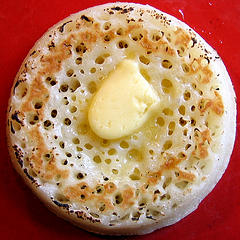
A crumpet is a savoury/sweet bread snack made from flour and yeast. It is eaten mainly in the UK and other nations of the Commonwealth. Crumpets are generally eaten hot with butter with or without a second (sweet or savoury) topping. Popular second toppings are cheese (melted on top), honey, poached egg, jam, Marmite, salt, marmalade, peanut butter, chese spread, goldern syrup, hummus, lemon curd, maple syrup and Vegemite. The butter may be omitted - but a phrase very commonly associated with crumpets is "dripping with butter".
Breakfast vocabulary around the world : 'Goetta'

Goetta is a peasant food of German origin that is popular in the greater Cincinnati area. It is primarily composed of ground meat and oats.The dish originated with German settlers from the northwestern regions of Oldenburg, Hannover and Westphalia who emigrated to the Cincinnati area in the 19th century. The word "Goetta" comes from the Low German word götte.
Goetta was originally a peasant dish, meant to stretch out servings of meat over several meals to conserve money.
The modern popularity of goetta in Cincinnati has led to it being called "Cincinnati Caviar". Glier's Goetta, the largest commercial producer of goetta, produces more than 1,000,000lb annually, around 99% of which is consumed locally in greater Cincinnati.
Breakfast vocabulary around the world : 'Huevos rancheros'

Huevos rancheros (Ranch Eggs) is a classic Mexican breakfast dish popular throughout much of the Americas consisting of eggs served in the style of the traditional large mid-morning fare on rural farms. The basic dish consists of fried eggs served upon lightly fried corn tortillas topped with a tomato-chili sauce. Refried beans, slices of avocado, or guacamole accompany the dish.
Breakfast vocabulary around the world : 'Grits'
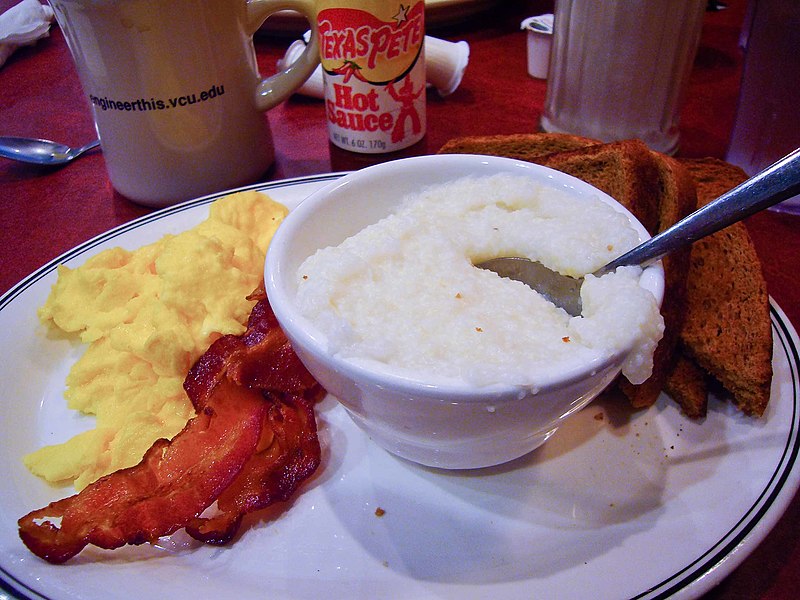
Grits is a food of Native American origin that is common in the Southern United States; it mainly consists of coarsely ground hominy. It is sometimes called sofkee or sofkey from the Creek word. The name 'grits' likely derives from the Northern European grit gruels. It is similar to other thick maize-based porridges from around the world, such as polenta. It also resembles farina, a thinner porridge. Grits can also be fried in a pan or mold to create a firm block. The resulting block can be cut with a knife or wire, and the slices are fried in a fat such as vegetable oil, butter or bacon grease.
Subscribe to:
Posts (Atom)